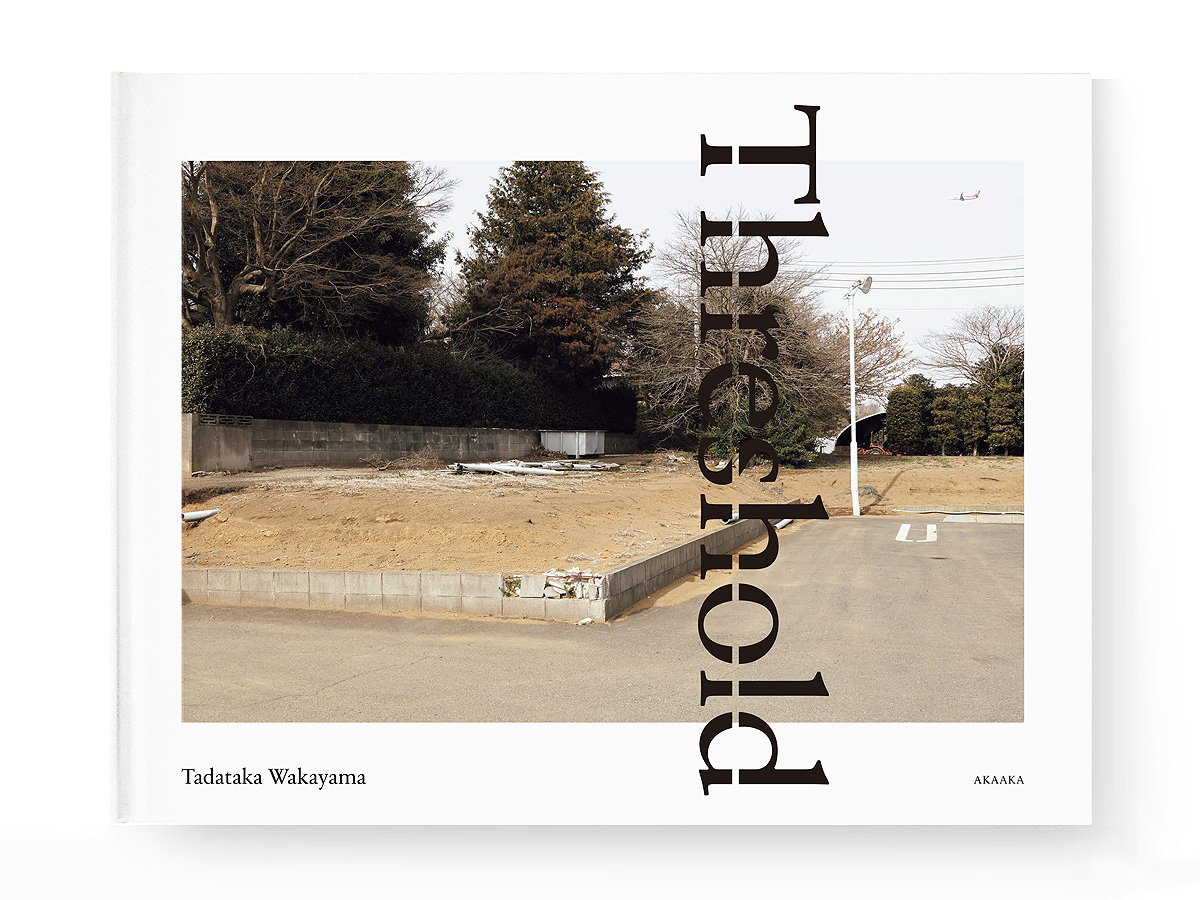
若山忠毅『閾』
Book Design:木村稔将
発行:赤々舎
Size:H228mm×W300mm
Page:136 pages
Binding:Hardcover
Published in January 2026
ISBN:978-4-86541-218-5
¥ 5,000+tax
国内送料無料!
About Book
境界が曖昧になる地点に立ち現れる風景
──成田空港周辺から
若山忠毅による写真集『閾|Threshold』 は、2013年以降、成田空港周辺で継続的に撮影されてきた写真作品から構成されています。
そこに写し出される風景は、出来事を説明したり、特定の立場を主張したりするものではありません。むしろ、何かが起きた「あと」にもなお残り続けている場所の気配や、意味が定まらないまま佇む空間のあり方が、静かに差し出されています。
成田空港とその周辺は、激しい反対運動の歴史を内包し、長い時間をかけて姿を変えながら、いまもなお更新され続けている場所です。
本書に収められた写真は、その変化の過程を記録するというよりも、過去と現在、内と外、公と私といった境界が曖昧になる地点に立ち現れる風景を見つめています。
撮影に際して、明確な結論や物語を設定することなく、空港周辺を歩き、主に飛行機の発着の方向に視線を向ける── 場の既存のイメージを分節化し、その背後にある別の空間性を静かに浮かび上がらせようと試みる撮影の積み重ねによって浮かび上がってくるのは、どこかに属しているようで、同時にどこにも回収されない空間の姿です。
また、写真の並びは撮影日ではなく撮影地点に基づいています。空港の北側を起点として概ね西側から東側へ反時計回りで空港を一周するなかで、同じ場所を別日に撮影した写真が複数現れる一方、ときに写真は撮影年の降順にも現れます。
空港敷地内に反対派住民の土地があることや、そこから空港の外へ通じる道があること── 本書の構成における複雑さは、未だ完成せずに在る成田空港という存在の複雑さでもあり、撮影地点に沿った順路にもかかわらず、ときに逆行するシークエンスは、行きつ戻りつしながら進んできた空港の歴史を想起させます。
写真集のタイトルである「閾(しきい)」は、ある場所から別の場所へと移る際に立ち止まる境界であり、また、認識が定まる直前の不確かな領域をも示唆しています。
本書は、風景を理解するための答えを提示するのではなく、その手前に立ち、見る者それぞれの感覚や記憶を静かに呼び起こす一冊となっています。
なお巻末には、若山忠毅によるテキストとともに、松田貴子による寄稿文を収録しています。異なる視点から紡がれる言葉が、写真と緩やかに呼応しながら、本書の射程を広げています。
Threshold
Tadataka Wakayama
More than half a century has passed since its opening, and Narita Airport remains unfinished. What has become of it now? In 2013, when Wakayama happened to stop near the airport, he visited the Toho and Tenjinmine districts of Narita City, prompted by a simple curiosity about the present state of affairs. At that time, he had no knowledge of the circumstances surrounding the construction of the airport described above.
What he encountered was an intermingling of farmland and residential land with a distinctly suburban character–transformed from what must once have been a pastoral landscape. Of course, it is still possible to find, here and there, parcels of land belonging to residents who had lived in the area prior to the airport’s construction and who opposed its development.
Yet what had emerged, in a context separate from both the pre-airport landscape and the events surrounding the airport conflict, was the appearance of homogenized environments now ubiquitous throughout Japan.
The suburban condition Wakayama observed overlaps with what Edward Relph describes as “placelessness” in Place and Placelessness.
Relph defines placelessness as a sameness of appearance and atmosphere that weakens the identity of places to such an extent that they offer only bland, undifferentiated experiences. Despite the history of conflict over the airport’s construction, the omnipresence of such placeless spaces appeared to have eroded the existential value of the surrounding area, as past confrontations and memories seemed gradually to be buried within the homogenized landscape.
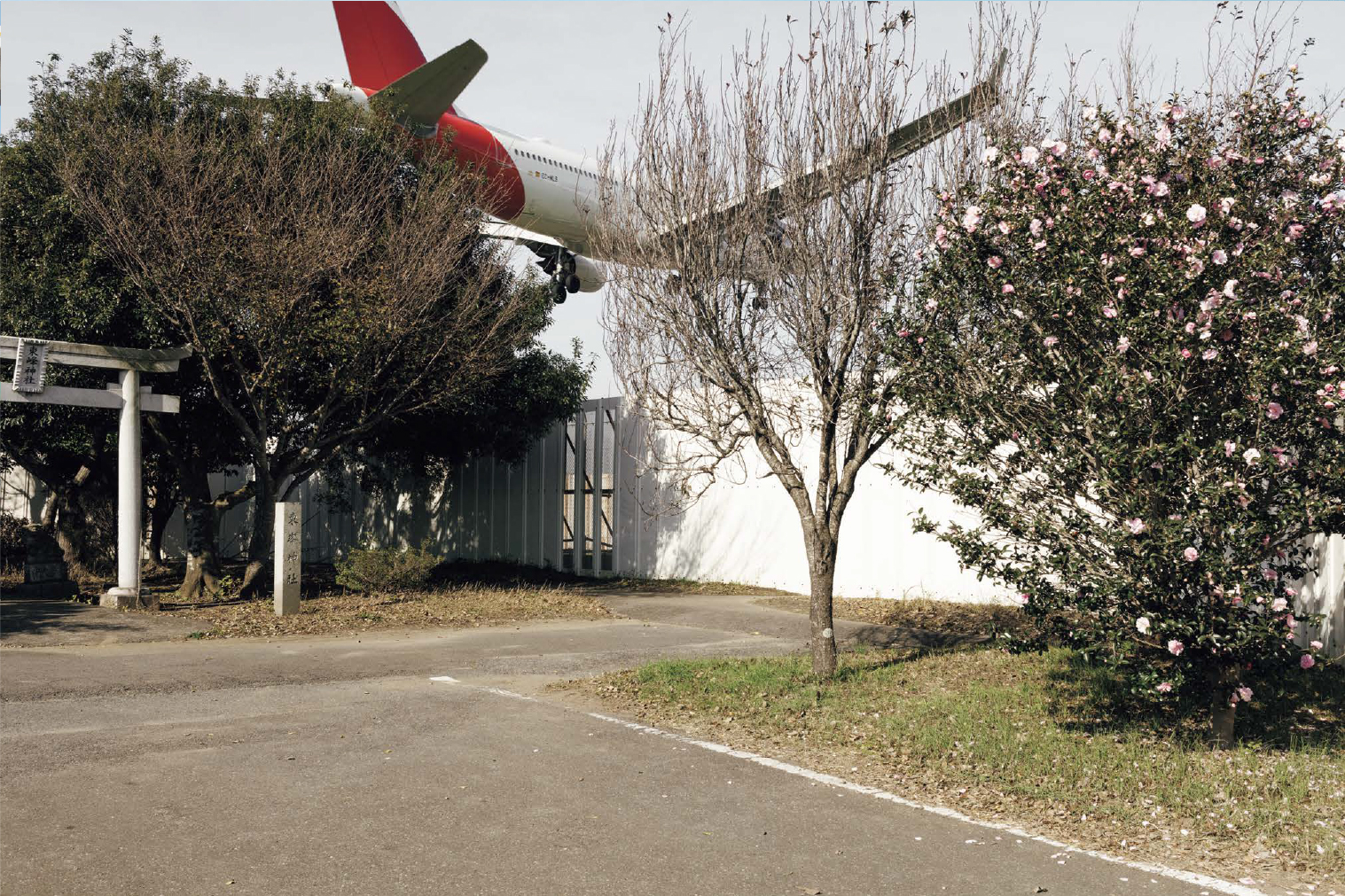
Looking up at the sky, one sees airplanes repeatedly taking off and landing.
Yet this alone does not endow the space with inherent meaning. What, then, constitutes the reality of the Narita Airport environs–so sharply at odds with images of nostalgic pastoral scenery or the violence of protest movements? Initially, Wakayama relied on his impressions of the site and decided to explore the area around the airport.
As he moved from place to place, he deliberately pointed his camera toward the airplanes taking off and landing as much as possible, imposing this constraint in order to restrain his own photographic preferences. Under these self-imposed rules, he repeatedly reconstructed past and present images of the Narita Airport environs, fragment by fragment.
Specifically, this involved taking locations that still evoke the struggles of the past, detaching them from their political and ideological contexts, mentally segmenting the images in his memory, and repositioning them in an attempt to give them a different spatiality.
Through the repetition of this photographic approach, Wakayama came to notice something.
The airport (the state) versus the rural village (community) were not the only subjects that shaped this place.
It has also been shaped by complex interventions of airport-related companies and individuals. In other words, beside the long-established friction between airport and village, there exists a “white space” that cannot simply be reduced to a “placeless” space derived solely from the interventions of diverse interests.
As he reviewed the vast number of photographs he had taken around the airport, his impression from preexisting photographs and videos he had seen gradually receded, and he began to gain a new understanding of the reality of this place that was distinctly different from conventional representations.
As mentioned above, the landscapes around Narita Airport had gone through several transitions even prior to the airport’s construction.
What he has been observing at the far end of this history is what he believes to be a “threshold” space that has become buried inside the changing consciousness of people.
A threshold denotes either the minimal measurable level or boundary at which one becomes aware of sensation or perception, or a buffer zone between private and public spaces. If we follow this definition, could the “threshold” be understood as a liminal space–with meaningful history and meaningless homogenization–lying between the public space of the airport and the personal space of privately owned land, or occupying the “gap” between places that evoke memories of struggle and those with a banal suburban character?
By reconstructing Wakayama’s own recognition and conceptions of the Narita Airport environs and, by extension, the appearance and character of the land itself, he expected that the inherent uncertainty of the place would become apparent.
That is to say, equating today’s Narita Airport area to a “threshold” seemed to involve the discovery of space that wavers within the complexity of social, regional, and personal relations, while continually questioning the tacit assumptions that underlie them. The airport and its surroundings emerge as an uncertain existence. These “thresholds” still exist today, testifying to the unresolved tensions that arose from events and uses of living spaces associated with the construction of the airport.
At present, Narita International Airport Corporation is undertaking the extension of Runway B and the construction of a third runway.
Related Exhibitons
若山忠毅 写真展「閾|Threshold」
会期: 2026年1月7日(水)〜1月21日(水)
時間:13:00〜19:00
会場:PURPLE(京都市中京区式阿弥町122-1 3F)
トークイベント 若山忠毅 × 中澤有基
日時:1月10日(土)15:00〜16:30
詳細
Artist Information
若山 忠毅
1980生まれ。2011年早稲田大学芸術学校空間映像科卒業。
主な個展、2024「閾」ニコンサロン(東京)、2023「パスとエッジ」 Alt_Medium(東京)、2020「離合/集散」Kanzan Gallery (東京)など。
主なグループ展、2014「第10回写真 1_WALL」ガーディアン・ガーデン(東京)など。
TAP Gallery元メンバー。
Tadataka Wakayama
Born in 1980. Graduated from Art and Architecture School of Waseda University in 2011.
Selected solo exhibitions include Threshold (Nikon Salon, Tokyo, 2024); Path and Edge (Alt_Medium, Tokyo, 2023); and Parting/Gathering (Kanzan Gallery, Tokyo, 2020).
Selected group exhibitions include 10th Photography 1_WALL (Guardian Garden, Tokyo, 2014).
Former member of TAP Gallery.
.